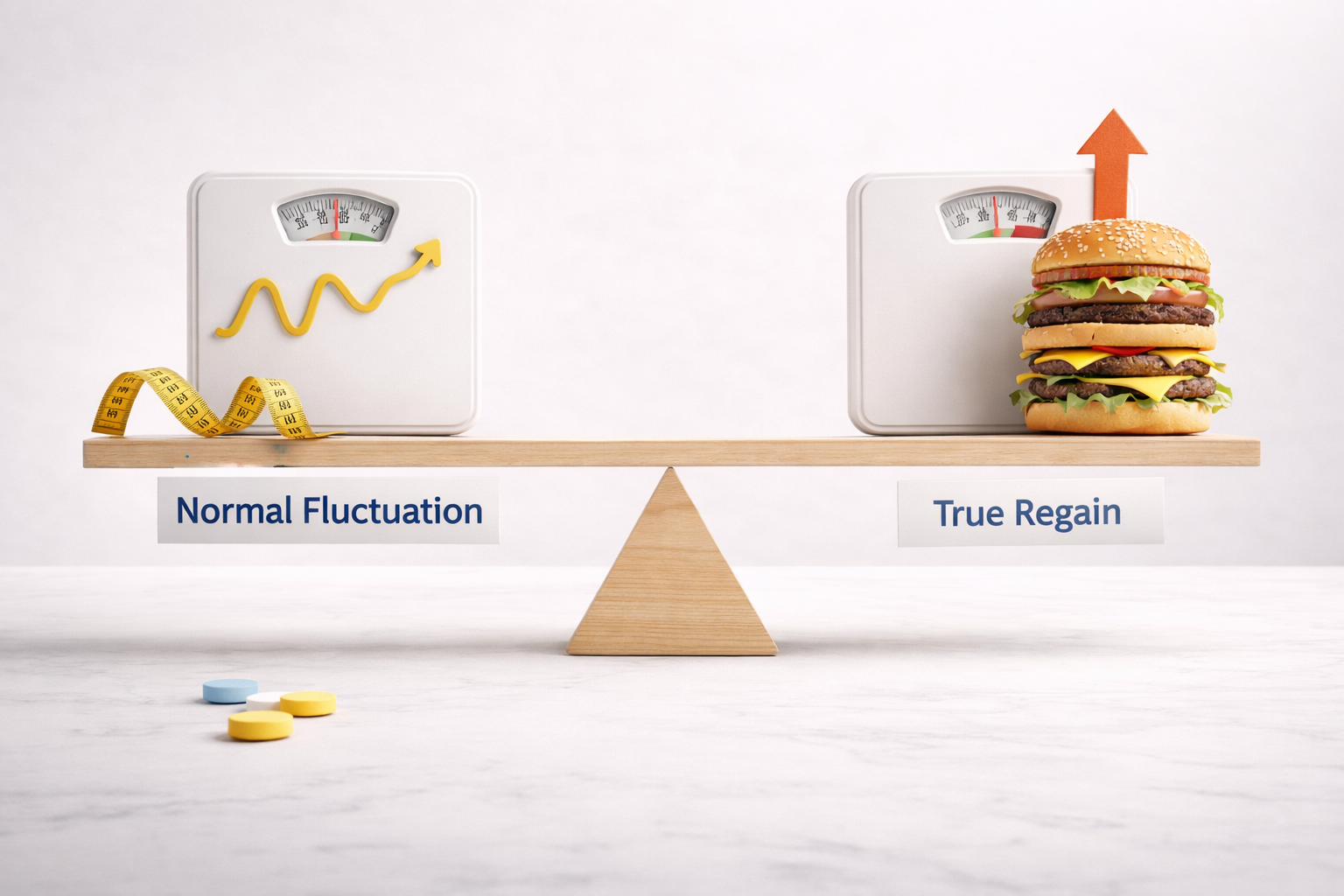
Weight Fluctuations Vs Regain
Few moments feel more unsettling after weight loss than seeing the number on the scale rise.
Even a small increase can trigger immediate worry:
“Is this the start of regain?”
“Am I losing control?”
“Was the weight loss temporary?”
These reactions are completely understandable — especially after the structure of GLP-1 medications changes or ends.
But here is one of the most important truths of the maintenance phase:
Not every increase on the scale represents fat gain.
In fact, most short-term weight changes are normal biological fluctuations, not true regain.
Learning to distinguish between the two is one of the most powerful skills in long-term weight maintenance.
Why the Scale Feels More Emotional After Weight Loss
During active weight loss, the scale usually moves downward regularly.
Each reading reinforces progress.
In maintenance, that pattern changes.
Weight stabilises — and stability includes movement in both directions.
Because expectations remain shaped by weight loss mode (see Weight loss mode vs maintenance mode), even small increases can feel alarming.
But stability is not a straight line.
It is a range.
What Counts as a Normal Weight Fluctuation?
Body weight naturally changes day to day.
For most people, fluctuations of 1–2 kilograms across days or weeks are completely normal.
These changes often reflect shifts in:
- Hydration levels
- Glycogen storage
- Digestive contents
- Hormonal cycles
- Sodium intake
- Sleep quality
- Stress levels
None of these represent body fat gain.
Fat accumulation occurs gradually and requires sustained energy surplus over time.
The Science Behind Daily Weight Changes
Your body stores carbohydrates as glycogen in muscles and liver.
Each gram of glycogen binds several grams of water.
This means:
- Eating more carbohydrates one day may temporarily increase scale weight.
- Reduced carbohydrate intake may lower it again.
Similarly, hydration changes alone can alter weight noticeably without affecting body composition.
These processes are normal signs of a responsive metabolism — not failure.
Why Fluctuations Often Increase After GLP-1 Treatment
After reducing or stopping GLP-1 medication, appetite and digestion gradually normalise.
(See: Why appetite changes after GLP-1 medications.)
As eating patterns become more flexible:
- Meal sizes vary slightly
- Sodium intake changes
- Digestive timing shifts
The result is often greater short-term variability on the scale.
Ironically, this variability usually reflects a return to normal physiology.
What True Weight Regain Actually Looks Like
weight fluctuations vs regain: True regain differs from normal fluctuation in one key way:
It appears as a consistent upward trend over time.
Signs of genuine regain include:
- Gradual increases across several weeks
- Rising weekly averages
- Clothes fitting progressively tighter
- Appetite consistently exceeding routine patterns
Regain rarely happens overnight.
It develops slowly — which means it can also be corrected early.
Why Reacting Too Quickly Can Backfire
A common response to a higher scale reading is immediate restriction.
People may:
- Skip meals
- Increase cardio dramatically
- Reinstate strict dieting rules
This reaction often creates instability.
Over-restriction increases hunger, fatigue, and food focus — making maintenance harder rather than easier.
Flexible structure (explored in: Building flexible food structure in maintenance) allows calm adjustment instead of panic correction.
The Importance of Tracking Trends, Not Days
One of the most helpful maintenance habits is shifting from daily interpretation to trend awareness.
Instead of asking:
“Did my weight go up today?”
Ask:
“What direction is my weight moving over several weeks?”
Methods that help include:
- Weekly averages
- Same-time weigh-ins
- Observing patterns rather than single numbers
This approach aligns measurement with biology rather than emotion.
When Should You Actually Adjust?
Small adjustments are helpful when:
- Weight trends upward consistently for 3–4 weeks
- Hunger patterns change noticeably
- Routines become irregular
- Activity levels drop significantly
Adjustments should be modest:
- Reintroducing meal structure
- Increasing protein consistency
- Returning to strength training rhythm
(See also: How protein supports weight maintenance and Why strength training matters more after weight loss.)
Large corrections are rarely necessary.
The Psychological Trap of “Starting Over”
weight fluctuations vs regain
Many people interpret fluctuations as evidence they must restart weight loss entirely.
This mindset creates unnecessary stress.
Maintenance success comes from course correction, not reset cycles.
Think of maintenance like steering a car:
Small adjustments keep you on course.
Oversteering creates instability.
Building Confidence in the Scale Again
Over time, successful maintainers change their relationship with weighing.
The scale becomes:
- A feedback tool
- A trend indicator
- A neutral source of information
Not a judgment.
Confidence grows when fluctuations are expected rather than feared.
A Helpful Mental Model — The Maintenance Range
Instead of a single goal weight, many experts recommend thinking in terms of a maintenance range.
For example:
- A 2–3 kg window where weight naturally moves.
Remaining within this range represents success.
Bodies are dynamic systems, not fixed numbers.
Allowing variability reduces anxiety and supports sustainable habits.
The Bottom Line
weight fluctuations vs regain
Weight fluctuations are normal.
True regain is gradual.
The difference lies not in a single reading but in long-term patterns.
Maintenance works best when you:
- Expect variability
- Watch trends calmly
- Adjust gently when needed
- Avoid extreme reactions
The goal is not preventing change entirely.
The goal is responding with confidence when change occurs.
Because long-term success is not measured by perfection — but by stability over time.
Support Through the Ups and Downs of Maintenance
Many people find the most challenging part of maintenance isn’t knowing what to do — it’s knowing when to act and when to stay calm.
Inside WeightMaintenance, members learn how to:
- Interpret weight changes confidently
- Make small course corrections early
- Build stable long-term routines
- Maintain progress without anxiety
If you’d like structured support during this phase:
Download our E-Guide to support your first 30-days of weight maintenance. Click HERE