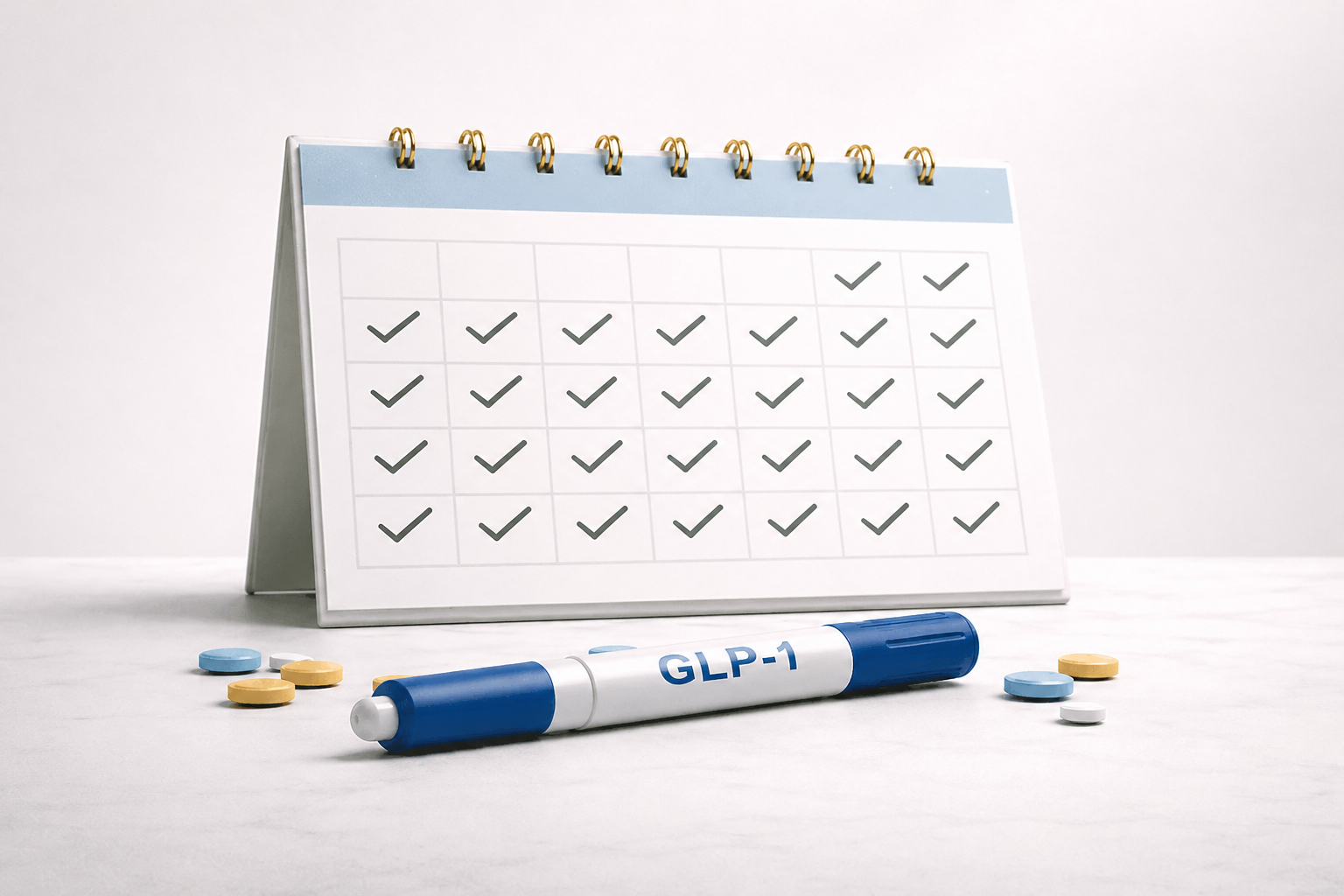
Many patients wonder if you can stay on weight loss drugs long term.
The answer depends on medical monitoring, goals, and lifestyle habits.
Long-term use:
- GLP-1s can be safe for long-term use in many individuals.
- Continued use supports appetite control and metabolism.
- Regular follow-ups monitor liver, kidney, and GI health.
Considerations:
- Permanent use isn’t mandatory; some transition to maintenance doses or lifestyle-only strategies.
- Cost and convenience may affect long-term adherence.
- Side effects may require dose adjustments.
Staying on GLP-1s long-term can be safe and effective, but individualized medical guidance is essential.
Is it Okay to Stay on Weight Loss Drugs Permanently?
For many people, GLP-1 medications are highly effective for weight loss.
But once results are achieved, a common question arises:
Should I stay on this medication long term — or come off it?
The answer is not the same for everyone.
Long-term use can be appropriate in some cases.
But it depends on your goals, your response, and your overall strategy for maintenance.
Why This Question Comes Up
GLP-1 medications are often started with weight loss in mind.
But weight regulation is not a short-term process.
After stopping medication, many people notice:
• Increased hunger
• Return of food noise
• Greater effort required to maintain habits
(See: Why Am I Hungrier After Stopping GLP-1 Medication?)
This leads to a natural question:
Would staying on the medication make maintenance easier?
Understanding GLP-1 as Long-Term Support
GLP-1 medications are not just weight loss tools.
They influence:
• Appetite regulation
• Satiety signals
• Food reward pathways
Because of this, some people use them as ongoing support — similar to how other chronic conditions are managed.
In this context, long-term use is not unusual.
It becomes part of a broader health strategy.
Potential Benefits of Staying on Medication
For some individuals, continuing medication may:
• Help stabilise appetite
• Reduce food noise
• Lower the risk of weight regain
• Make maintenance feel more manageable
This can be particularly helpful if:
• Hunger becomes difficult to manage without support
• Previous attempts at maintenance have been challenging
• Biological responses strongly favour regain
Medication can act as a support layer — not a replacement for habits.
Potential Downsides to Consider
Long-term use is not without considerations.
These may include:
• Cost and accessibility
• Side effects or tolerability
• Dependence on medication for appetite regulation
• The need for ongoing medical supervision
For some people, these factors influence the decision to reduce or stop.
There is no universally “correct” choice — only what is sustainable for you.
The Psychological Side of Staying on GLP-1
For many, the decision is not purely medical.
It also involves identity and perception.
Common thoughts include:
• “Should I be able to maintain this on my own?”
• “Am I relying too much on medication?”
• “What happens if I stop later?”
These concerns are understandable.
But using a tool that supports your health is not a weakness.
(See: Shifting Identity After Major Weight Loss.)
Maintenance Dose vs Full Dose
Staying on weight loss drugs long term does not necessarily mean continuing at a full dose.
Options may include:
• Reducing to a maintenance dose
• Adjusting frequency
• Using medication intermittently under guidance
(See: I’ve Reached My Target Weight – Now What? Understanding Maintenance Dose)
This allows for flexibility while still providing support.
Can You Maintain Without Medication?
Yes — many people do.
But it requires:
• Structured eating patterns
• Awareness of appetite signals
• Consistent routines
• Behavioural strategies
(See: How Do I Maintain My Weight Without Medication Support?)
The key difference is that you replace medication support with skill-based systems.
How to Decide What’s Right for You
The decision to stay on weight loss drugs long term should be individual.
Consider:
• How manageable your appetite feels without it
• Your ability to maintain routines consistently
• Your previous experience with weight regain
• Your preferences around medication use
There is no single path.
The goal is sustainability — not ideology.
Reviewing Your Approach Over Time
Your needs may change.
What works now may not be what you need in a year.
It is helpful to:
• Monitor appetite and weight trends
• Reassess periodically
• Adjust your approach as needed
Flexibility is part of long-term success.
The Bottom Line
To stay on weight loss drugs long term can be appropriate for some people.
It can:
• Support appetite regulation
• Reduce the risk of regain
• Make maintenance more manageable
But it is not the only option.
Long-term success comes from:
• Understanding your body
• Building consistent habits
• Choosing the level of support that works for you
You are not choosing between right and wrong.
You are choosing what allows you to maintain your results in a sustainable way.
Support Making the Right Decision
Deciding whether to stay on weight loss drugs long term can feel complex.
Inside WeightMaintenance, members receive:
• Guidance on long-term maintenance strategies
• Support navigating medication decisions
• Tools for managing appetite and habits
• Ongoing help through each phase
If you want support choosing the right long-term approach:
Download our E-Guide to support your first 30-days of weight maintenance. Click HERE